

Menu
Held in Hanoi on November 17, 2026, the Twin Transition Growth Forum 2026 was jointly organized by the Agency for Private Enterprise and Collective Economy Development under Vietnam’s Ministry of Finance and the Deutsche Gesellschaft für Internationale Zusammenarbeit (GIZ). During the panel discussion titled “Strengthening Twin Transition Support Services for SMEs,” FPT IS shared a practical approach to transformation, emphasizing how businesses can begin with small improvements to everyday workflows that align with their available resources.
A key highlight of the forum was the official launch of the Digital and Green Transformation Maturity Assessment Tool (TMA), designed to help businesses assess their current capabilities, identify areas for improvement, and define appropriate transformation roadmaps. However, translating these roadmaps into action remains challenging, particularly for SMEs facing financial, workforce, and technological constraints. These challenges were central to discussions among experts and business representatives seeking practical, achievable approaches to twin transition.

Deputy Minister of Finance Tran Quoc Phuong delivers the opening remarks at the forum.
FPT IS Contributes Practical Insights to the Twin Transition Support Ecosystem
The panel discussion brought together representatives from government agencies, international organizations, business associations, and technology and financial service providers to explore ways to strengthen the twin transition support ecosystem for SMEs. The Agency for Private Enterprise and Collective Economy Development under Vietnam’s Ministry of Finance (APED) outlined policy directions and support mechanisms, while GIZ emphasized the importance of connecting resources, developing assessment tools, and strengthening advisory services aligned with international standards. The discussion was moderated by Ms. Nguyen Huong Quynh, Director of BambuUP.
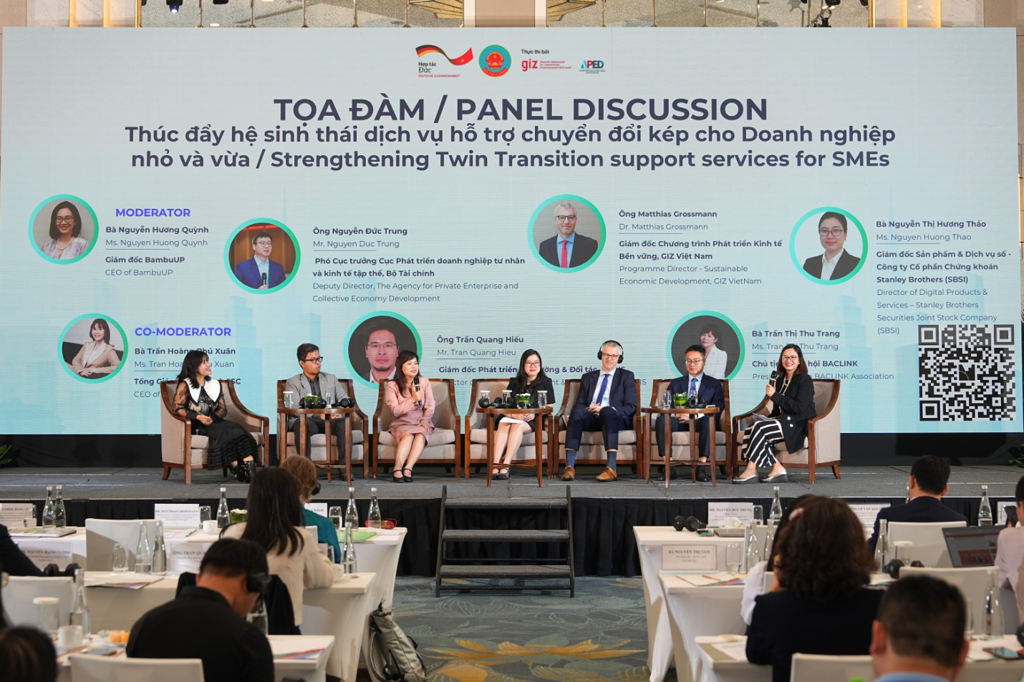
Panel discussion: “Strengthening Twin Transition Support Services for SMEs.”

Dr. Michaela Baur, Country Director of GIZ Viet Nam, delivers remarks at the forum.
The discussions highlighted that twin transition extends beyond technology adoption. It requires coordination among policy frameworks, financing, advisory expertise, and practical implementation capabilities. According to a live survey conducted during the session, 43% of responses indicated a need for a rapid assessment of transformation readiness, while 36% expressed interest in identifying technology solutions suitable for their business scale. These findings underscored the importance of connecting business assessments with accessible, practical support services.
Representing the technology solution provider perspective, Mr. Tran Quang Hieu, Director of Market Development and Partnerships at FPT IS, emphasized the foundational role of data in enabling twin transition. By digitizing production, business, and operational activities, enterprises can gain greater visibility into performance, identify inefficiencies, and improve resource management. Systematically managed data can also provide a foundation for greater transparency and help businesses progressively respond to sustainability-related requirements.
Drawing on practical experience in technology implementation, the FPT IS representative stressed that businesses do not necessarily need to begin with complex systems or simultaneous investments across multiple areas. Instead, prioritizing specific operational activities where improvements are achievable and aligned with available resources can establish a foundation for gradually expanding transformation efforts. This approach raises an important practical question: Where should businesses begin to achieve their first measurable results?
From Electronic Invoicing to FPT SPro: Starting with One Workflow to Scale Transformation
Digital transformation does not necessarily require large-scale technology investments from the outset. Businesses can begin by addressing a bottleneck in an existing workflow, measuring the improvements, and gradually extending successful practices. These early achievements, or quick wins, can help demonstrate the value of digital investment and build internal support for broader transformation.
Electronic invoicing illustrates how technology can improve everyday business operations. Replacing paper invoices with electronic records reduces dependence on physical documents and makes transaction data easier to store, retrieve, and manage. However, digitizing invoices does not automatically mean that the workflows surrounding them have also been digitized. For example, after receiving an electronic invoice for office supplies, an employee may still need to manually enter invoice details into a payment request form, forward supporting documents between departments, and follow up on approvals. These remaining manual tasks represent specific opportunities for improvement without requiring a complete overhaul of business operations.
Beyond document management, standardized electronic invoice data may also support certain business management and ESG reporting activities when combined with other relevant data sources.
To address these operational gaps, FPT SPro enables businesses to configure payment request workflows according to their needs. Using a visual process designer based on BPMN 2.0, users can build workflows through drag-and-drop actions, define document verification and approval steps, and test different processing paths before deployment.
When an employee uploads an invoice, AI Assistant can use OCR technology to recognize and extract invoice information, suggest a suitable payment request workflow, and automatically populate the relevant form. After the employee reviews and confirms the information, the request is created and follows the configured approval process. AI can also summarize supporting documents, reference internal policies, and flag missing information, providing additional support to authorized reviewers.
By starting with a single workflow, businesses can measure improvements in processing time, manual data entry, and approval turnaround. Once the benefits become evident, the same implementation approach can be extended to other workflows, creating a cumulative effect that supports broader organizational transformation.
Through solutions such as FPT SPro, FPT IS aims to help businesses turn practical operational improvements into a foundation for long-term digital transformation and sustainable growth.
From assessing transformation readiness to implementing practical improvements, twin transition requires sustained collaboration and long-term commitment. Alongside government agencies under Vietnam’s Ministry of Finance, GIZ, BambuUP, and other ecosystem stakeholders, FPT IS continues to contribute its technological expertise and practical experience, helping translate transformation strategies into concrete actions that deliver tangible value to the business community.
Read more:
– Paperless Office: How the FPT IS Digital Ecosystem Drives the Twin Transition and Supports ESG Goals
– Paperless Office and ESG: Reducing Paper Consumption and Preventing Waste in Line with GRI 306
– Paperless Office and the Social Pillar of ESG: Beyond Productivity
– From Approvals to Invoices: How Paperless Workflows Support ESG Governance