
Under the Department of Taxation’s e-invoicing system upgrade roadmap, XAdES is expected to be introduced from November 2026. FPT.eSign already supports XAdES, helping businesses prepare for upcoming technical requirements in e-invoicing.

In manufacturing, machinery leaving a factory or goods being dispatched from a warehouse does not necessarily trigger an obligation to issue an electronic invoice. Similarly, in banking, financial services, and insurance (BFSI), […]

On October 9, 2026, FPT IS – FPT Corporation received a Certificate of Commendation from the Department of Taxation for exemplary tax compliance, recognizing its fulfillment of state budget obligations and contribution to Vietnam’s economic development.

With 250,000 invoices issued daily and less than a month to migrate, FPT combined temporary manual invoicing with API integration to meet the retailer’s deadline.

Vietnam’s e-invoice framework has evolved through Decree 123/2020/NĐ-CP, Decree 70/2025/NĐ-CP, and Decree 254/2026/NĐ-CP, reflecting a gradual shift toward more integrated digital tax administration.

Issued on June 30, 2026 and effective from July 1, 2026, Decree 254/2026/NĐ-CP provides the new regulatory framework for electronic invoices and electronic documents under the Law on Tax Administration No. 108/2025/QH15.

A system designed to standardize operations across markets has a natural limitation: not every country-specific requirement can be embedded in the ERP core. This gap is particularly relevant in markets where tax, invoicing, accounting and reporting requirements change quickly.
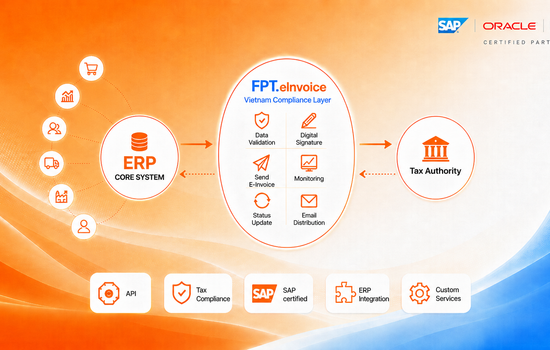
Across pharmaceuticals, logistics, and multinational operations, FPT.eInvoice extends ERP data into invoicing, tax, and local compliance while preserving a unified management architecture.

Input invoices (purchase invoices) are very important documents for every business, especially in cost accounting and tax declaration. However, accountants at small businesses often make some common mistakes related to input invoices.