

Menu
Vietnam’s e-invoice framework has evolved through Decree 123/2020/NĐ-CP, Decree 70/2025/NĐ-CP, and Decree 254/2026/NĐ-CP, reflecting a gradual shift toward more integrated digital tax administration.
This article compares how the three decrees changed regulatory objectives, scope, applicable entities, and business requirements. It also highlights how e-invoice compliance has become more closely connected to digital systems, data flows, and tax administration.
Context and Objectives of Each Decree
Decree 123/2020/NĐ-CP (2020): Decree 123 established the nationwide framework for e-invoicing and set common rules for invoice issuance, management, transmission, and storage, supporting the transition from paper-based processes to electronic tax administration
Decree 70/2025/NĐ-CP (2025): Decree 70 amended and supplemented Decree 123 to address implementation issues and changes in business practices, including invoice issuance timing, e-invoices generated from cash registers, error handling, and the use of invoice information
Decree 254/2026/NĐ-CP (2026): Effective July 1, 2026, Decree 254 replaced the previous framework under Decree 123, as amended by Decree 70. It reorganizes the rules on e-invoice issuance and management, electronic documents, data transmission, information systems, and the responsibilities of relevant parties under the new Law on Tax Administration.
Taken together, the three stages show a clear regulatory progression: Decree 123 established the nationwide e-invoice framework, Decree 70 refined that framework in response to implementation needs, and Decree 254 replaced and reorganized it under the new Law on Tax Administration while retaining a number of mechanisms developed under the previous framework

Scope and Applicable Entities
The regulatory scope evolved from the broader invoice-and-document framework under Decree 123, through targeted amendments under Decree 70, to a framework focused specifically on e-invoices, electronic documents, and related data systems under Decree 254.
Decree 123/2020/NĐ-CP: Decree 123 covered invoices for the sale of goods and provision of services, as well as documents used in tax, fee, and charge procedures. Its scope included both e-invoices and certain paper invoices and documents. The applicable entities included enterprises, cooperatives, household and individual businesses, other business organizations, buyers, taxpayers, tax and fee collection bodies, organizations responsible for personal income tax withholding, service providers, and tax authorities.
Decree 70/2025/NĐ-CP: Because Decree 70 amended Decree 123 rather than replacing it, the core scope and categories of applicable entities remained in place. The amendments expanded or clarified the framework in specific areas, including foreign suppliers without a permanent establishment in Vietnam that voluntarily register to use e-invoices, e-invoices generated from cash registers, and requirements for particular business models and transactions.
Decree 254/2026/NĐ-CP: Decree 254 centers the regulatory scope on e-invoices and electronic documents. It covers their types and users, contents and issuance timing, management and storage, data connection and transmission, information systems, and the provision and use of invoice information. Applicable entities continue to include enterprises and economic organizations, household and individual businesses, buyers, taxpayers, tax and fee collection bodies, organizations and individuals with tax-withholding or tax-filing responsibilities, service providers, tax administration authorities, and other related parties
Impact on Businesses
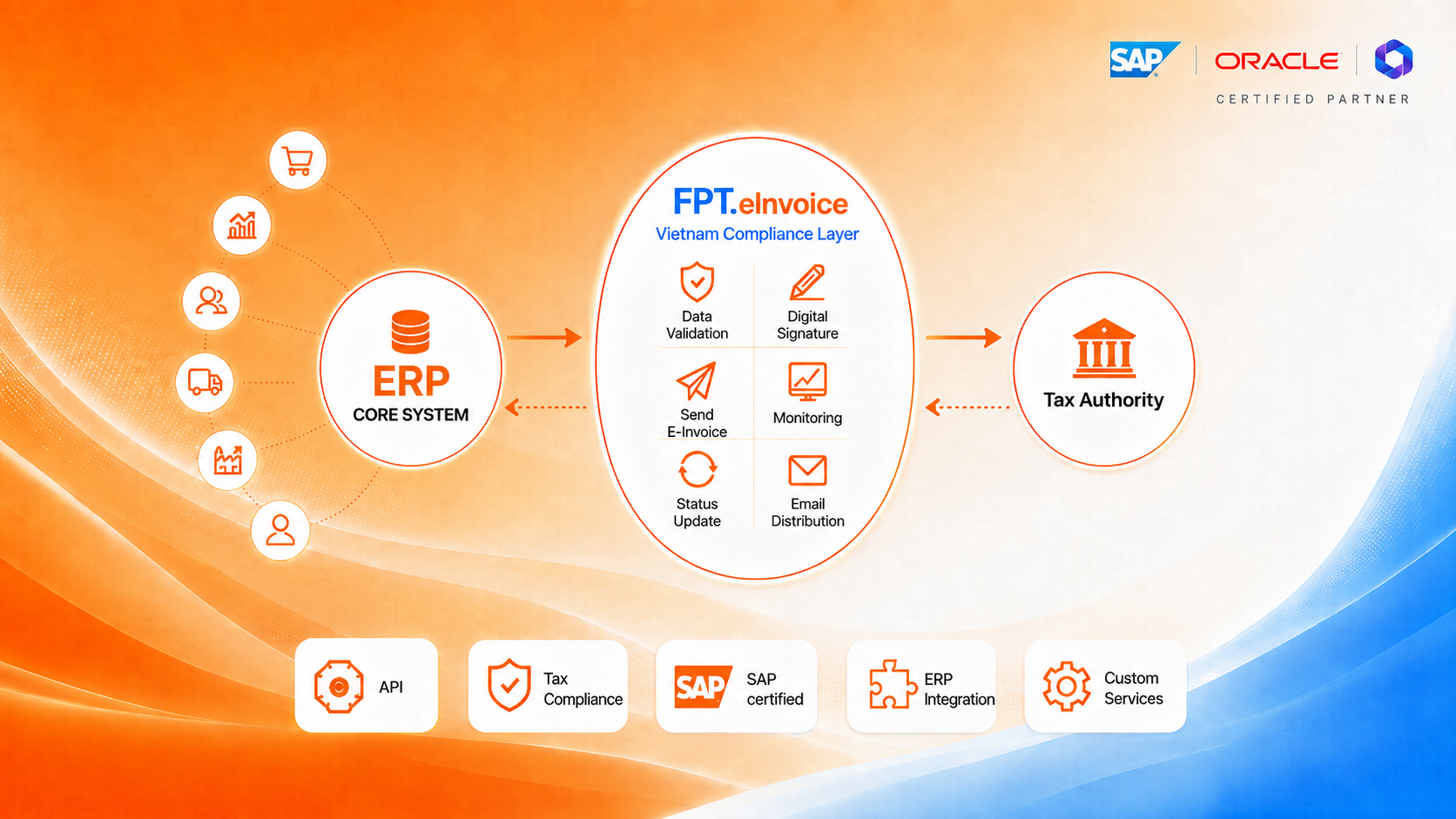
Changes in the e-invoice framework affect businesses well beyond the accounting function. Each regulatory stage has required enterprises to adjust how invoices are issued, reviewed, reconciled against transaction data, transmitted, and stored across accounting, ERP, POS, and other operational systems. As invoice data becomes more closely integrated with tax administration, compliance increasingly depends on whether these systems can apply the correct invoicing rules at the point where a business transaction occurs
Decree 123/2020/NĐ-CP: The most immediate impact of Decree 123 was the nationwide transition to e-invoices. From July 1, 2022, enterprises and other taxpayers within the prescribed scope had to move away from paper-based processes and issue invoices electronically. In practical terms, this required businesses to establish electronic invoice workflows, use digital systems to issue e-invoices and store invoice data, and transmit that data to the tax authority either directly or through e-invoice service providers. For businesses already operating accounting or ERP systems, invoicing increasingly became part of a connected transaction flow rather than a separate administrative step performed after the underlying sale or service transaction.
Decree 70/2025/NĐ-CP: The 2025 amendments did not require businesses to undergo another wholesale digital transition, but they did require many existing invoice processes and system configurations to be reviewed. Changes to invoice issuance timing, invoice contents and rules for specific sectors meant that businesses had to ensure that the event triggering an invoice in their accounting, sales or operational systems remained consistent with the amended requirements. Decree 70 also further developed the framework for e-invoices generated from cash registers, increasing the relevance of POS-to-e-invoice and e-invoice-to-tax-authority data flows for businesses selling directly to consumers. These changes meant that compliance increasingly depended not only on whether a business could issue an e-invoice, but whether its systems could issue the correct invoice, with the required information, at the correct point in the transaction
Decree 254/2026/NĐ-CP: The move to Decree 254 creates another layer of operational adjustment because businesses must review their invoicing processes against a newly reorganized framework rather than simply continue applying Decree 123 as amended. The new rules refine the rules on invoice issuance timing and content for a wider range of transaction models, including digital and platform-based services, and introduce more detailed requirements for some businesses with electronic transaction-management systems. They also affect how invoice data is transmitted. For e-invoices generated from cash registers connected to the tax authority, sellers are generally required to transmit invoice data to the tax authority at the end of the day, subject to specific rules for certain services.
For businesses, the practical implication is that the transition to Decree 254 is not simply a matter of updating the legal references displayed in invoice software. Accounting, ERP, POS and e-invoice systems may need to be checked against revised rules on invoice issuance triggers, mandatory data fields, transaction classification, data-transmission timing and error-handling procedures. Internal controls also need to reflect which system supplies the source data, when an invoice is issued, how subsequent corrections are processed and how information is ultimately transmitted to the tax authority. The regulatory transition therefore moves the compliance question from simply “Can the business issue an e-invoice?” toward “Can its transaction systems consistently produce and transmit compliant invoice data throughout the business process?”

Advantages, Challenges, and Notable New Features
Key Advantages and New Features:
- A more specific error-handling mechanism for e-invoices generated from cash registers: Where an e-invoice generated from a cash register contains an error, the new framework requires the seller to issue a replacement invoice rather than make an invoice adjustment
- Clearer rules on the use of different e-invoice forms: Decree 254 further specifies when taxpayers use e-invoices with a tax authority code, e-invoices without a code, or e-invoices generated from cash registers. For household and individual businesses, those with annual revenue exceeding VND 1 billion, or those carrying out transactions involving assets subject to ownership or use-right registration, are required to use an e-invoice with a tax authority code or an e-invoice generated from a cash register connected to the tax authority
- More explicit rules for when an e-invoice is or is not required: Decree 254 provides more explicit rules for cases in which e-invoices are not required, reducing ambiguity for a number of specific business situations. It also further specifies invoice issuance timing for transaction models that depend on periodic data reconciliation, including digital technology services, digital platforms, insurance, electronic advertising, passenger transportation, crypto assets, and carbon-market transactions. For service contracts, a deposit collected solely to secure contractual performance, before any sale of goods or provision of services occurs, does not itself trigger invoice issuance, while sellers without automated invoicing software that make sales during statutory night-working hours may issue the invoice no later than the following working day.
- More detailed requirements for transaction and invoice data: The framework further develops requirements concerning seller and buyer information, descriptions of goods and services, invoices issued to consumers, delegated invoice issuance, auction transactions, and information required for certain transportation services. For certain consumer-facing services that maintain detailed transaction records through an electronic transaction-management system, the framework allows transaction data to be managed and transmitted under the prescribed data-reporting mechanism instead of requiring a separate invoice for every individual transaction
- Stronger rules for electronic documents and system-based tax administration: Decree 254 does not focus solely on sales invoices. It further develops the framework for electronic tax documents, including how electronic documents are issued, connected, and transmitted, as well as the transmission of electronic receipt data. It also introduces or clarifies rules on system incidents and the respective responsibilities of sellers, tax authorities, and e-invoice service providers. This expands the regulatory focus from issuing compliant invoices to maintaining a functioning electronic data flow across the wider tax-administration process.
Remaining Challenges:
- A compressed implementation window: Decree 254 was issued on June 30, 2026 and took effect on July 1, 2026. For businesses, software vendors, and service providers, this leaves little formal transition time for reviewing the new requirements, updating system configurations, testing invoice issuance and data-transmission rules, and communicating changes to operational teams.
- More granular rules require more precise system configuration: As invoice issuance timing, mandatory data fields, transaction classifications, and data-transmission requirements become more specific to particular industries and transaction models, businesses need to ensure that accounting, ERP, POS, e-commerce, and e-invoice systems apply the correct rules to the correct transaction. The challenge is therefore increasingly one of data mapping and workflow configuration, rather than simply whether a business has an e-invoice solution installed.
- Compliance increasingly cuts across multiple functions: Correct invoice issuance may depend on source data originating from sales, operations, logistics, customer systems, POS platforms, or ERP modules before it reaches the e-invoice system. Businesses therefore need closer coordination between tax, accounting, legal, IT, and operational teams to determine which data is authoritative, when an invoice should be issued, how transaction data should be reconciled, and how corrections or subsequent changes should flow through connected systems. For smaller taxpayers and household businesses, the additional digital and operational requirements may also require changes in systems, working practices, and staff capabilities.
Conclusion
Decree 254/2026/NĐ-CP marks the next stage in Vietnam’s e-invoice and electronic-document framework, building on the nationwide adoption established under Decree 123 and the refinements introduced by Decree 70. Rather than changing direction entirely, the new framework reorganizes and updates existing mechanisms under the new Law on Tax Administration, with greater emphasis on electronic data, system connectivity, and more specific compliance requirements.
For businesses, the key implication is that e-invoice compliance increasingly depends on how accurately transaction data is captured, reconciled, and transmitted across accounting, ERP, POS, and other operational systems. The transition therefore requires not only legal updates, but also closer alignment between business processes, system configuration, and tax compliance.