

Menu
- The gap between “having an ERP” and “having an end-to-end transaction flow” lies in whether data can continue to be used after the core ERP process is completed.
- GONSA: When success is no longer measured by “the API is integrated”
- Multinational enterprises: Standardized governance, localized invoicing
- When invoicing sits inside a multi-system logistics chain
- Back to the wood industry: Not every industry has the same “invoice trigger”
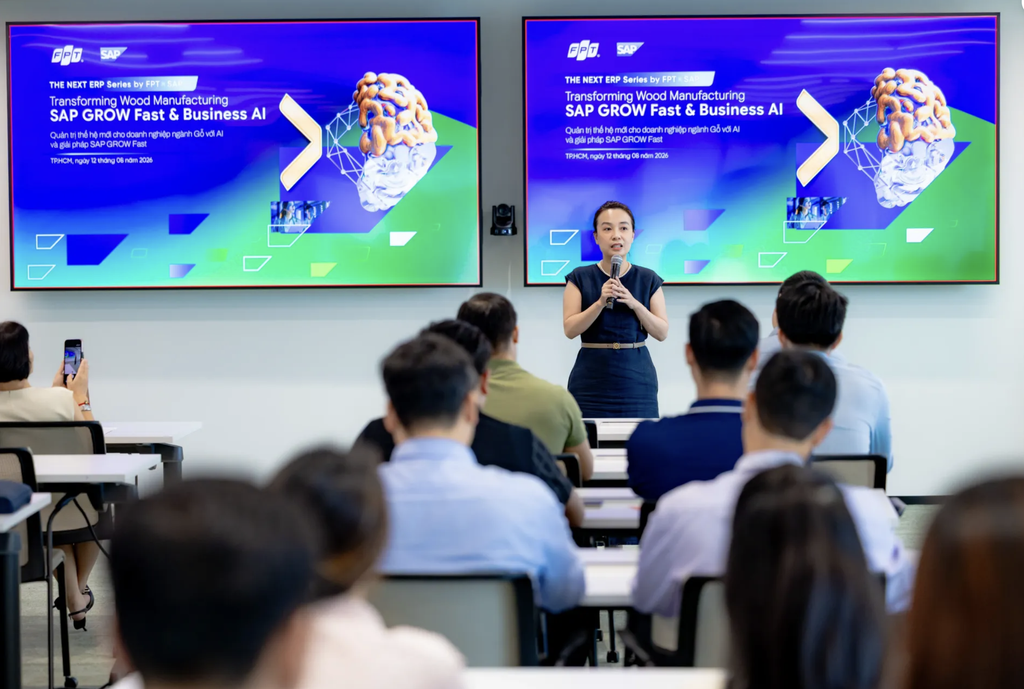
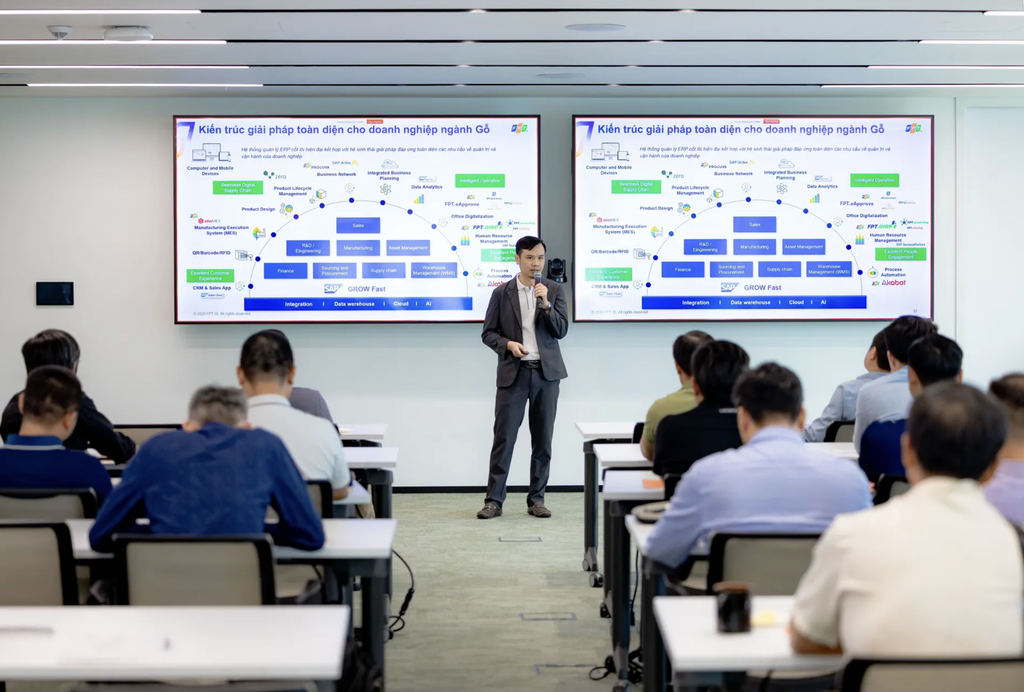
On August 12, 2026, in Ho Chi Minh City, FPT and SAP hosted the event “Transforming Wood Manufacturing with SAP GROW Fast & Business AI,” focusing on the management challenges facing wood manufacturers and exporters. In the first five months of 2026, Vietnam’s exports of wood and wood products reached approximately USD 7.12 billion, up 4.4% year on year. Behind this growth, however, businesses are facing mounting pressure to control costs, raw materials, material loss, make-to-order production, traceability, and compliance with international requirements such as the EU Deforestation Regulation (EUDR).
Founded in 1972, German technology company SAP was one of the pioneers that helped shape the global ERP software market. SAP platforms bring core functions such as finance, procurement, manufacturing, supply chain, and sales onto a unified management system. Today, more than 800 enterprises in Vietnam operate on SAP platforms.
For the wood industry, SAP GROW Fast extends this approach across industry-specific processes, from quotations and sales orders to bills of materials, production, warehousing, and finance and accounting, with a roadmap from current-state assessment to go-live in approximately three months. The value lies not simply in adding another ERP system, but in connecting data seamlessly across the entire operating cycle on a common management platform.
Yet a business transaction does not end when goods leave the warehouse or when an invoice is created. On the sales side, data continues through the entire invoice lifecycle: digital signing, transmission to and from the tax authority, invoice status tracking, storage and retrieval, accounts receivable recognition, payment, and reconciliation. On the procurement side, businesses must receive supplier invoices, validate them, match them against purchase orders and goods receipt data, route them for approval, recognize accounts payable, and post them into the accounting system or ERP.
For wood companies with a high proportion of exports, the process extends further into import-export operations. Each shipment is associated with customs declarations, transport documents, customs value, and documentation proving the origin of raw materials. These records need to remain consistent with sales orders, deliveries, and invoices to reduce discrepancies in declarations, customs clearance, and post-transaction reconciliation. If ERP, invoicing systems, and import-export data operate in isolation, manual work remains at multiple points even when production and finance have already been digitized.
The gap between “having an ERP” and “having an end-to-end transaction flow” lies in whether data can continue to be used after the core ERP process is completed.
If invoice data still has to be exported, re-entered, or reconciled through a separate process, the business effectively creates a parallel source of data. As operations scale from one plant to multiple plants, from one company to multiple legal entities or markets, the volume of manual data entry, checking, and reconciliation grows accordingly.
In this architecture, SAP manages core processes across procurement, inventory, production, sales, and finance, while FPT.eInvoice connects transaction data from source systems to the electronic invoicing process. For outbound invoices, the solution supports issuance, delivery, management, storage, retrieval, and data exchange with the tax authority. For inbound invoices, FPT.eInvoice – Inbound Invoice Processing supports invoice collection, data extraction, validation, matching, and approval before data is transferred into ERP or accounting software. Certain validation and supplier-identification tasks can be automated in approximately eight seconds per invoice. As a result, invoicing no longer exists as a separate accounting process; it remains connected to procurement, sales, receivables, payables, and financial data already controlled within the enterprise system.
This integration capability was formally recognized by SAP on August 7, 2025, when FPT.eInvoice became the first solution in Vietnam to be listed among integration providers for SAP Document and Reporting Compliance. SAP continues to list FPT IS Company Limited, FPT Corporation for outbound B2B and B2C electronic invoicing in Vietnam, providing last-mile connectivity via API for SAP S/4HANA Cloud Public Edition.
Under this model, SAP remains the core management platform and source of transaction data, while FPT.eInvoice handles the electronic invoicing layer and local compliance requirements. This separation allows enterprises to preserve a standardized ERP core while addressing market-specific invoicing requirements in a specialized layer, thereby limiting the need for deep SAP customization whenever regulations change.
GONSA: When success is no longer measured by “the API is integrated”
GONSA demonstrates the value of this model at the process level. After nearly 200 days of implementation, the company put five technology systems into operation simultaneously on January 1, 2024. The project involved approximately 250 personnel and integrated 176 business flows, with RISE with SAP S/4HANA Cloud serving as the foundation connecting procurement, inventory, sales and distribution, and finance.
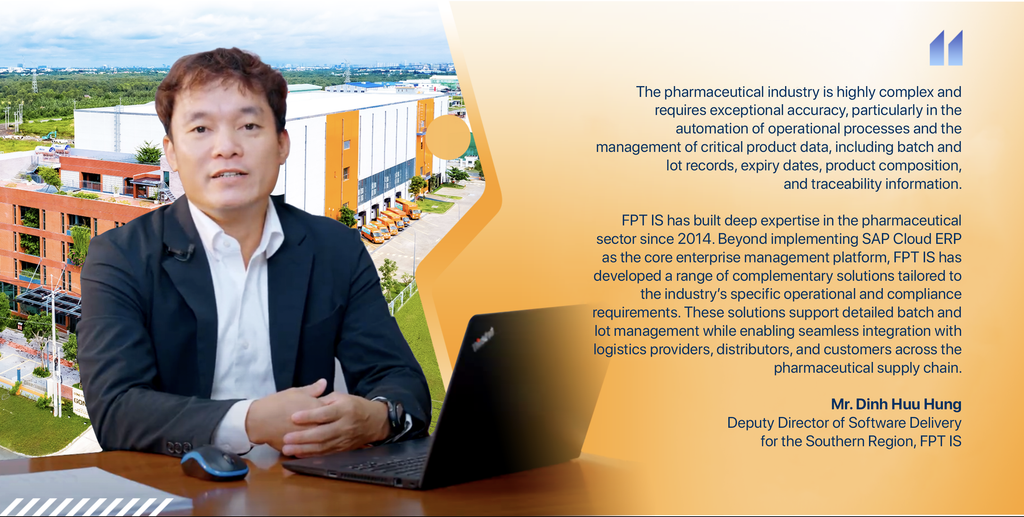
GONSA processes thousands of invoices and orders each month. Before automation, both inbound and outbound invoice processing depended heavily on manual work, creating significant pressure during financial close periods. Following implementation, the system not only validates invoice information against tax authority data, but also matches pharmaceutical batch numbers and expiry dates against SAP Cloud ERP. Valid invoices continue through the process automatically, while exceptions are separated for user review. Invoice verification time has been reduced to one to two minutes per invoice, while data-entry errors have been eliminated within the automated workflow.
Across automated processes in the Accounting and Purchasing functions, GONSA saves approximately 1,100 working hours per month.
For a CFO, the figure of 1,100 hours per month is more meaningful than simply saying that “the integration was successful.” The efficiency gain comes from reducing the number of times people need to touch the same data: batch numbers and expiry dates no longer need to be rechecked in a separate system, invoices do not need to be re-entered from scratch, and reconciliation results do not have to be compiled manually at period-end. When transaction data remains consistent at source, processing time and control costs decline together.
This is particularly important in pharmaceuticals. Matching invoices back to batch numbers and expiry dates illustrates a fundamental principle: an invoice must remain linked to the transaction that generated it. If a company digitizes only the invoice document without connecting it to the underlying goods, inventory, and financial data, it has digitized a document—not the transaction itself.
Multinational enterprises: Standardized governance, localized invoicing
For a multinational group operating in machinery and construction equipment, with a commercial and distribution network spanning more than 190 countries and territories, over 60 overseas companies, more than 300 dealers, and approximately 2,000 service outlets, the ERP challenge extends well beyond manufacturing management. It also requires sales, distribution, service, and finance to operate coherently at global scale. While the management platform can be standardized at group level, invoicing and tax processes must still comply with the legal requirements of each market.

In December 2021, one manufacturing entity within the group went live with SAP S/4HANA ERP, integrating finance and accounting, procurement and inventory, sales, production, and process management on a single system. In 2025, FPT deployed FPT.eInvoice for one of the group’s companies in Vietnam, integrating it with the existing management system via API so that invoice issuance data could be synchronized automatically rather than re-entered manually into a separate system. In 2026, the model was further extended to Malaysia, with the implementation adapted to local operating requirements and e-invoicing regulations.
What matters is not simply that the same customer launched another project in a second country. The more important capability is the ability to reuse transaction data sources, integration principles, and synchronization flows while localizing the invoice process for each market—including data structures, validation rules, document types, processing statuses, and methods of exchanging information with tax authorities.
In Vietnam, transaction data is transferred from the enterprise management system to FPT.eInvoice for invoice creation, issuance, and data exchange with the tax authority in accordance with the applicable requirements for each invoice type.
In Malaysia, the process must comply with the local e-Invoice framework: invoice data is standardized to Malaysian requirements and submitted to the Inland Revenue Board of Malaysia (IRBM/HASiL) for near-real-time validation. Processing results are then returned for subsequent invoice status management. Data fields such as the Tax Identification Number (TIN), Business Registration Number (BRN), Malaysia Standard Industrial Classification (MSIC) code, e-Invoice Classification Code, and tax information must also be mapped to Malaysian standards.
The challenge becomes even more complex when a single group operates multiple business models. In addition to manufacturing and equipment sales, the group also provides financial services including financing for key customers, dealer financing, and financial leasing. Its financial services network has served more than 1,000 customers and dealers across multiple markets, including Malaysia.
In such cases, differences arise not only from country-specific regulations. A machine sale, spare-parts transaction, or financial service may involve different invoice timing, source data, payment schedules, and receivables treatment. E-invoice integration therefore needs to follow the actual business flow that generated each transaction rather than imposing one identical invoicing process on every company within the group.
This is the value of scalability across both markets and business models: the enterprise retains a unified core management platform, while the invoicing layer adapts to country-specific regulations and transaction characteristics without creating additional disconnected data flows.
When invoicing sits inside a multi-system logistics chain
Another representative case involves a logistics company operating at global scale. In logistics, an invoice is rarely generated from a single sales transaction. It is typically the outcome of an entire chain spanning orders, transportation, customs clearance, warehousing, delivery, reconciliation, and freight settlement. The company’s scale illustrates the complexity of ERP and e-invoice integration: it operates through a network of approximately 380 locations worldwide, including around 320 warehouses across 36 countries, connects with more than 60 shipping lines, and serves more than 13,000 customers.
Its technology environment connects order management, forwarding, customs clearance, warehousing, transportation, and settlement. The underlying architecture includes SAP, WMS, GSI, master data management and document management systems, together with API/EAI integration layers. This means that the data required for invoicing is generated across multiple process steps and systems before it reaches accounts receivable/payable, payment, and accounting. The integration challenge is therefore not merely to issue an invoice, but to ensure that invoice data is inherited from and matched against the correct underlying transaction, revenue, and cost records.
The integration model between FPT.eInvoice and the company’s management systems has been in place since 2021, when the outbound invoicing solution was connected to SAP for sales invoice issuance. This established the foundation for the integration to expand across both business processes and markets in subsequent years.
In July 2024, as the company rolled out its Global eInvoice Hub (EIMS) to centralize inbound invoice data processing and support cost accounting, FPT integrated its inbound invoice processing solution with EIMS for the company’s Vietnam operation. Vietnam was the second market in the EIMS rollout. The project went live in approximately two months, automating invoice collection, legal compliance checks, and matching against logistics document sets, with a processing volume of around 100,000 inbound invoices per year.
Also in 2024, as Malaysia introduced its e-Invoice requirements, FPT deployed FPT.eInvoice for outbound invoicing at the company’s Malaysian operation, continuing to use SAP as the source system in the integration flow. Transaction data from SAP is transferred to FPT.eInvoice for invoice processing and exchange with the Malaysian tax authority’s system. The project went live in August 2024 after approximately four weeks, supporting around 100,000 outbound invoices per year.
By late 2025 and early 2026, as EIMS was further expanded to Malaysia, FPT continued to support the company by integrating FPT.eInvoice – Inbound Invoice Processing with the centralized invoice management platform. This allowed Malaysia’s inbound invoice process to remain connected to the company’s broader management architecture instead of becoming a separate country-level workflow. The project went live after approximately 2.5 months of implementation.
From SAP-integrated outbound invoicing in 2021 to integration with the Global eInvoice Hub in Vietnam and Malaysia between 2024 and 2026, this case demonstrates the scalability of FPT.eInvoice across three dimensions: transaction volume, process scope, and market coverage. More importantly, as the operating architecture expands, invoice data continues to inherit from source transactions and feed back into receivables, costs, payments, and accounting within a multi-system logistics environment.
Back to the wood industry: Not every industry has the same “invoice trigger”
The wood industry event on August 12 showed that ERP is increasingly moving deeper into industry-specific processes rather than merely standardizing finance and accounting. Wood manufacturers deal with make-to-order production, variable material requirements, loss rates that depend on wood type, data dispersed between factories and offices, and growing requirements for transparency in raw material origin and supply chains to meet export-market standards.
This is precisely why the invoicing layer must be considered within the broader transaction chain.
On the procurement side, data begins with material requirements, purchase orders, and goods receipt. Supplier invoices need to be linked to the underlying purchase transaction, receiving or warehouse data, and payment obligations. If accounting staff still re-enter invoices manually, the enterprise creates another source of data alongside ERP.
On the sales side, the finance and accounting data chain may run from quotation → sales order → bill of materials → production → warehouse → delivery → billing document → electronic invoice → receivables → payment. Outbound invoices therefore need to inherit data from the sales orders and deliveries that have already been controlled upstream.
For CFOs, the value of this architecture lies in three areas: stronger data control, lower transaction-processing costs, and the ability to scale without increasing accounting and reconciliation resources at the same rate. For CEOs, the value lies in the ability to add factories, companies, or markets without fragmenting the management architecture into separate local systems.
With GONSA, FPT × SAP demonstrates the ability to integrate electronic invoicing directly into ERP around the specific requirements of the pharmaceutical industry: batch numbers, expiry dates, inventory, invoice, and accounting data are connected within the same processing chain, producing measurable benefits in the form of thousands of working hours saved.
For a global logistics enterprise, that integration capability extends into a multi-system logistics chain, where invoices must inherit data from orders, forwarding, customs, warehousing, transportation, and settlement, while supporting both inbound and outbound invoicing across multiple markets.
For multinational groups with companies in different countries and operating under different business models, FPT further demonstrates the ability to scale e-invoice–ERP integration while localizing it for each market: the enterprise maintains a common management platform, while the invoicing layer is adapted to transaction-specific requirements and the legal framework of each country.
The wood industry sits directly at the intersection of these requirements. A single enterprise may have highly specialized manufacturing processes, multiple factories, trading companies, and export markets. As the business scales, the value of FPT.eInvoice is no longer defined by how many invoices it can issue, but by how effectively invoicing can be embedded into the transaction flow already controlled by ERP.
The same logic applies across many other industries. Pharmaceuticals need to link invoices to batch numbers and expiry dates. Logistics must connect transportation orders, customs, warehousing, delivery, freight charges, and settlement. Machinery and equipment businesses may combine machine sales, spare parts, services, and financing. FMCG and retail businesses handle high transaction volumes across many points of sale. Import-export businesses add foreign currencies, transportation, customs, and multiple layers of documentation.
Industries differ in the data and processes that generate invoices, but they share one principle: data should not have to be recreated once it has already been validated in the source system.
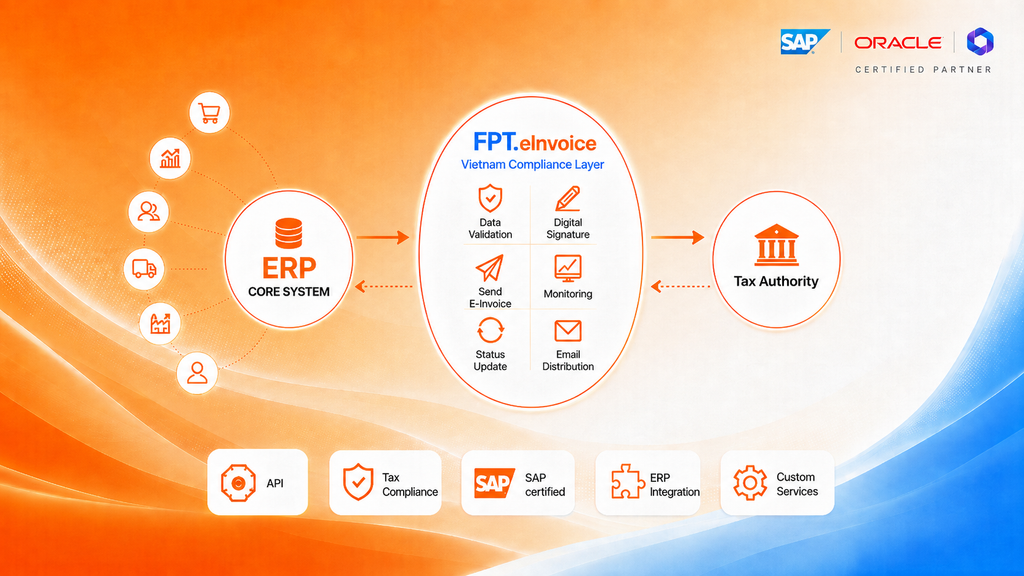
This is also why ERP × FPT.eInvoice capability cannot be evaluated simply by looking at a technical interface. From FPT.eInvoice being formally recognized by SAP for e-invoice connectivity in Vietnam, to GONSA saving 1,100 working hours per month, and to FPT.eInvoice expanding with customers from Vietnam to Malaysia, the value lies in connecting three layers that are often managed separately: industry-specific operations, global enterprise management systems, and local compliance requirements.
SAP standardizes and governs core transactions, while FPT.eInvoice and FPT’s broader digital financial ecosystem carry that data through the invoice, tax, receivables/payables, and accounting lifecycle. FPT’s capability lies in understanding the business process deeply enough to identify where data originates, understanding the systems well enough to integrate without disrupting the management architecture, and understanding local requirements well enough to complete each transaction in compliance with regulation.
As enterprises expand across industries, factories, legal entities, or countries, the best system is not the one with the most software. It is the one in which each transaction is created correctly once, and its data can continue to flow seamlessly from operations through invoicing, tax, and finance.
For enterprises looking to integrate e-invoicing with SAP, Oracle, Microsoft Dynamics 365, or existing ERP systems, please submit your information HERE or contact us via Hotline: 1900 636 191 / 0914 206 850.